Cold and heat sit at opposite ends of the recovery spectrum and get used interchangeably by people who haven’t thought about which is the right tool. They aren’t. Heat increases blood flow and warms muscle tissue. Cold reduces inflammation and perceived soreness. Each has a specific job and a specific cost, and the most common mistake is reaching for cold when heat would do more, or icing routinely when the inflammation is doing useful work.
This page covers the two products in the Rox Recovery cold-heat lineup, the science of when each actually helps a Hyrox athlete, and the routines that make sense versus the ones that just feel productive.
When heat helps a Hyrox athlete
Heat does three useful things for an athlete:
- Warms the muscle and connective tissue before loaded movement. Cold-stiff muscles are mechanically less compliant and statistically more injury-prone. Topical warming + dynamic warm-up addresses both the surface temperature and the deep movement quality.
- Increases peripheral blood flow. Warmth dilates surface vessels, which improves oxygen and nutrient delivery to muscle being asked to work harder. Useful pre-session.
- Long-form heat exposure (sauna) drives plasma volume expansion. 30+ minutes in a sauna multiple times per week has measurable cardiovascular effects — increased plasma volume, improved heat tolerance, marginal endurance gains. Most relevant for athletes with serious sauna access; a topical warming cream is the practical version of “heat application” most people will actually use.
The race-week-relevant case for Hyrox specifically: indoor venues in July (Sydney) and November (Melbourne) run cold. The warm-up area is shared and crowded. You can’t always move enough to stay warm. A topical warm-up cream applied 15-20 minutes pre-warm-up gives you a head start on tissue temperature without needing to spend 20 minutes jogging in the holding area.
When cold helps — and when it costs you
Cold-water immersion (CWI) and ice packs reduce perceived soreness and inflammation. The Bleakley 2012 Cochrane review (PMID 22336838) summarised the literature: cold immersion at 10-15°C for 10-15 minutes does reduce DOMS markers and perceived soreness compared to passive recovery.
The trade-off is well-documented. Roberts et al (2015) — among others — showed that routine post-training cold immersion blunts the acute anabolic signalling that drives muscle adaptation. The same inflammation that hurts is also the signal your body uses to rebuild stronger. Crush the inflammation every session, you crush the adaptation.
Practical implication: cold has a place, but it’s not “every session, daily, after every workout.”
When cold is a good idea:
- Acute injury within 24-48 hours. Sharp, localised pain — sprains, contusions, acute tendon flares. Ice 10-15 minutes, multiple times per day for 1-2 days.
- Race week. Reducing perceived soreness and getting back to baseline faster matters more than blunting adaptation, because there’s no adaptation happening in race week — just preservation.
- Post-race. Same logic. Compress recovery time and ignore the (minimal) adaptation cost from a single exposure.
- Multi-day events where you have to race again the next day or the same week. Trade adaptation for performance — the right call when the next race is hours away.
- Specific overuse hotspots that are flared up — patellar tendons, Achilles, lateral elbow. Ice the spot, not the whole leg.
When cold is a bad idea:
- After every prep-block training session. You’re paying with adaptation for a small reduction in soreness. Bad trade.
- As a “general health” daily routine. The cold-plunge wellness culture has overshot the evidence. Once or twice a week is fine; daily is overkill.
- Within 4-6 hours of a strength session you want to adapt to. If you’re trying to build strength or hypertrophy, give the inflammation cascade time to do its job before applying cold.
The Premax Warm Up Cream EP5 — race-day specifics
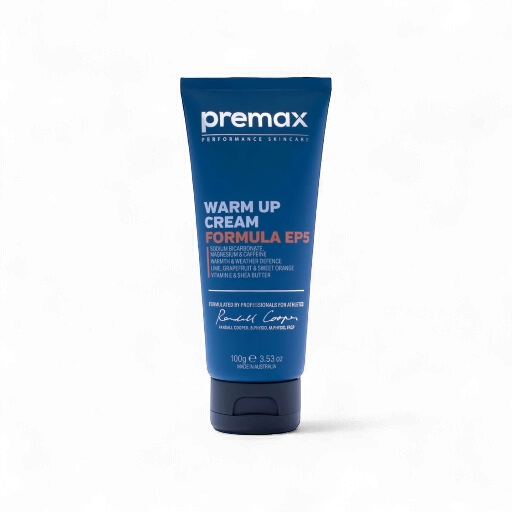
Premax is an Australian brand that’s quietly become standard kit at AU triathlon and cycling events. The EP5 formulation is their “warming cream” variant — sodium bicarbonate, magnesium, caffeine, and other actives in a topical cream that delivers a warming sensation and improves surface tissue temperature.
The Hyrox-relevant use cases:
- Pre-warm-up application on cold-venue race days. Apply 15-20 minutes before you start your dynamic warm-up to quads, calves, glutes, lower back, and lats.
- Pre-session application in cold winter training (early-morning sessions, outdoor running in winter, or training in unheated gyms).
- Pre-mobility for athletes with chronic stiff areas (lower back, hip flexors) — the warming effect makes early-session mobility more productive.
What it doesn’t do: it isn’t a replacement for an actual warm-up. The cream warms the surface tissue; the muscle and central nervous system still need the dynamic work. Apply, then warm up — not instead of warming up.
The 50% commission on this SKU reflects the brand’s strong AU market position; the product earns its place on race-day kit lists irrespective of that.
The Ice N Easy Ice Pack — when and how to use it
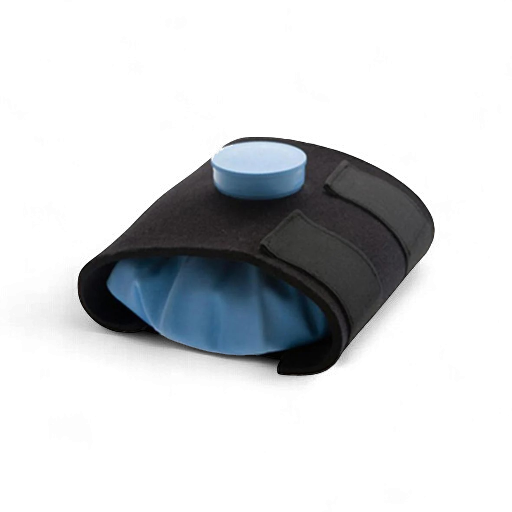
The Ice N Easy is a velour-rubber composite ice pack with an elastic strap. The velour reduces ice-burn risk for direct application — useful because most cheap ice packs require an awkward layer of fabric between the pack and the skin, which reduces effective cold transfer.
When it earns its place:
- Post-session for genuinely beat-up muscles — quads after a sled-push-heavy session, knees after a high-volume running week, shoulders after a hard SkiErg session. 15 minutes max, not after every session.
- Post-race day 1-2 for the worst-affected muscles. Use alongside the standard recovery protocol.
- Acute injury management in the first 24-48 hours — most often patellar tendon flares, Achilles flare-ups, lateral elbow tightness from grip work.
How not to use it: every day, on every muscle, “just in case.” Routine icing of normal soreness is unnecessary and may slightly impair adaptation. Save it for situations where it has a job to do.
How a Hyrox athlete should think about cold and heat across a prep block
Mental model: heat is your friend most of the time, cold is a tool you reach for in specific situations.
Pre-session, pre-race: heat (warm-up cream, dynamic warm-up, sauna if available)
Mid-prep block, normal sessions: neither — let the inflammation do its job, sleep well, eat enough protein
Post-race, race week, after a brutal simulation: cold is fine — adaptation is paused anyway
Acute injury or specific overuse flare: cold for the first 24-48 hours
Multi-day event: cold between sessions to reset the perceived-soreness clock
Daily cold-plunge habit: unnecessary, and at worst counter-productive during a build block
The other recovery tools — sleep, foam rolling, percussion massage, food, supplements — do more work than cold or heat for the typical Hyrox athlete. Don’t over-index on contrast therapy if the basics aren’t dialled.
The category lineup
Two products cover the practical cold and heat needs of a Hyrox athlete without overlap:
- Premax Warm Up Cream EP5 — pre-warm-up, race-morning, cold-venue races. The heat side of the spectrum.
- Ice N Easy Ice Pack — post-session for beat-up muscles, acute injury management, race week and post-race. The cold side.
For the broader DOMS protocol that ties cold and heat into the rest of recovery, see the DOMS pillar. For race-week kit specifically, see the Hyrox Sydney 2026 page.